How to Read a Supplement Label: Serving Size, % Daily Value, IU vs mcg
A line-by-line guide to the Supplement Facts panel: serving size, amount per serving, % Daily Value, units like mcg RAE and DFE, IU conversions and quality seals.
7 min read
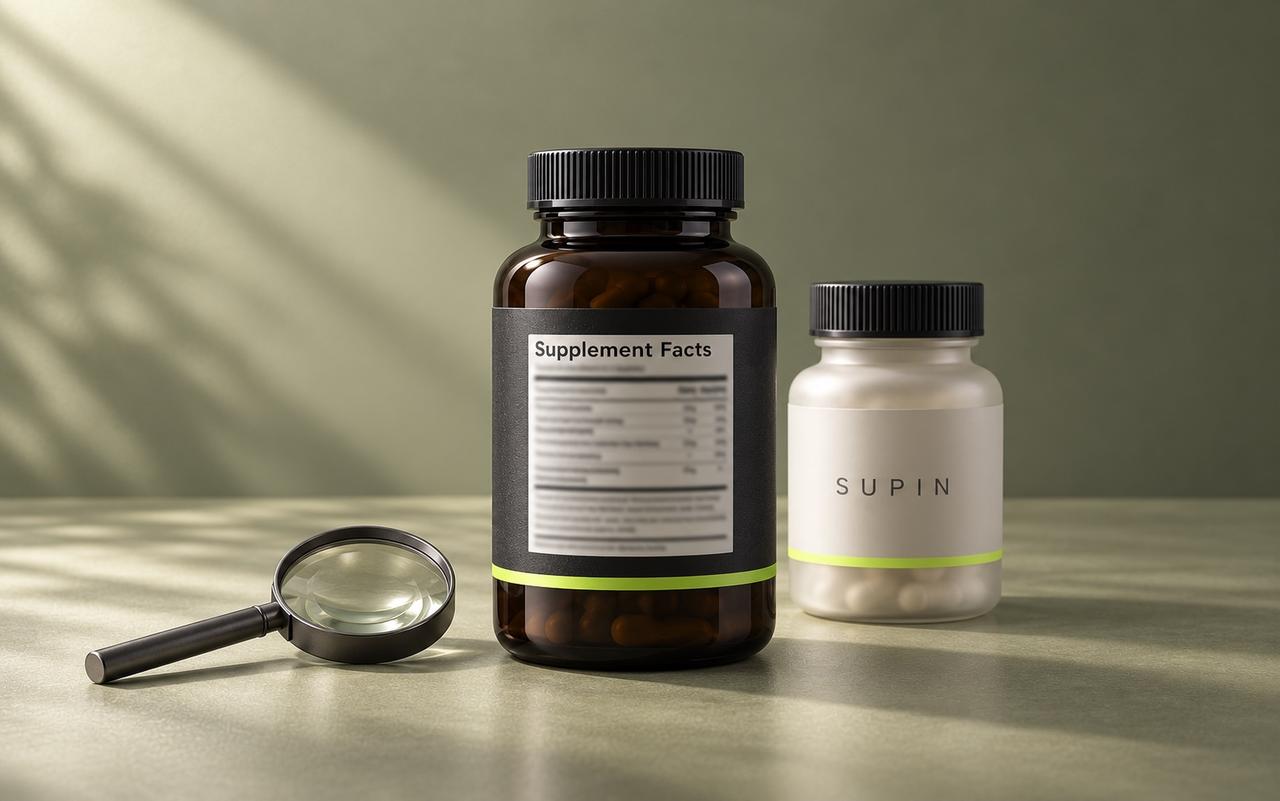
To read a supplement label, start with the Supplement Facts panel. The serving size tells you how many units the amounts refer to. "Amount per serving" shows how much of each nutrient that serving contains. % Daily Value compares it with a reference amount for a day. US labels now list vitamin D in mcg (1 mcg = 40 IU).
This guide walks through a US Supplement Facts panel line by line, using FDA rules and NIH fact sheets, and explains units such as mcg RAE and mcg DFE. If you track your products in Supin, its daily nutrient totals are built from exactly these label lines.
What is on a Supplement Facts label?
Every dietary supplement sold in the US carries a Supplement Facts panel. It lists the active ingredients, the amount per serving and, separately, other ingredients such as fillers, binders and flavourings[1]. From top to bottom:
- Serving size and, if it differs from the pack size, servings per container[2].
- Amount per serving for each dietary ingredient. It may be worded as "Each tablet contains" or "Amount per 2 tablets"[2].
- % Daily Value for nutrients that have one.
- Other dietary ingredients without a Daily Value, such as herbs or other compounds, marked with a symbol[2].
- Below the panel, the ingredient statement ("other ingredients"): binders, excipients and fillers[2].
Vitamins and minerals appear in a fixed order: vitamin A, C, D, E, K, then the B vitamins, then minerals such as calcium, iron and magnesium[2]. That makes two labels easy to compare side by side.
What does serving size mean on a supplement?
The serving size is the largest amount the label recommends for one occasion, or one unit if it gives no recommendation. If the directions say "take 1–3 tablets with breakfast", the serving size is 3 tablets[2].
This catches people out. Every amount and % Daily Value on the panel refers to the full serving. If the serving is 2 capsules and you take 1, you get half of each number. The manufacturer suggests the serving size, but your health care provider may decide a different amount suits you better[1].
What does % Daily Value mean?
% Daily Value (%DV) shows how much of a nutrient one serving contributes to a day's reference amount. The FDA's example: if the Daily Value for a nutrient is 300 mcg and a serving has 30 mcg, the %DV is 10%[3].
As a general guide, the FDA considers 5% DV or less per serving as low and 20% DV or more as high[3]. A %DV above 100% means the serving contains more than the Daily Value. That doesn't tell you whether the amount is right for you, so ask your doctor or pharmacist.
What does the asterisk (*) on a supplement label mean?
Ingredients with no established Daily Value still have to be listed with their amount. They are marked with a symbol in the % Daily Value column that points to the footnote "Daily Value not established"[2]. The FDA's own example of such an ingredient is phosphatidylserine[2].
What do mg, mcg, IU, mcg RAE and mcg DFE mean?
| Unit | What it is | Where you'll see it |
|---|---|---|
| mg | Milligram, a thousandth of a gram | Calcium, magnesium, iron, zinc, vitamin C, vitamin E[3] |
| mcg (µg) | Microgram, a thousandth of a milligram | Vitamin D, vitamin K, B12, biotin[3] |
| mcg RAE | Retinol activity equivalents: accounts for the different activity of retinol and beta-carotene[4] | Vitamin A |
| mcg DFE | Dietary folate equivalents: accounts for folic acid being absorbed better than food folate[5] | Folate |
| IU | International Units, the older unit for vitamins A, D and E | Older labels, or in brackets after mcg |
| CFU | Colony-forming units: live cells in a probiotic[6] | Probiotics |
Why did labels change from IU to mcg?
The FDA updated the Nutrition and Supplement Facts labels in a 2016 rule[7]. Manufacturers had to use the new labels from January 2020; companies with under $10 million in annual sales had until January 2021[8]. On the new labels:
- Vitamin D is listed in mcg. The amount in IU may be added in brackets[7].
- Vitamin E is listed in mg[8].
- Vitamin A is listed in mcg RAE instead of IU[4].
- Folate is listed in mcg DFE. If folic acid is added, the amount of folic acid in mcg follows in brackets[5].
How do I convert IU to mcg?
The conversion depends on the vitamin, and for vitamins A and E on the form. These factors come from the NIH Office of Dietary Supplements:
| Vitamin | Conversion |
|---|---|
| Vitamin D | 1 mcg = 40 IU, so IU ÷ 40 = mcg[7] |
| Vitamin E, natural (d-alpha-tocopherol) | 1 IU = 0.67 mg[8] |
| Vitamin E, synthetic (dl-alpha-tocopherol) | 1 IU = 0.45 mg[8] |
| Vitamin A as retinol | 1 IU = 0.3 mcg RAE[4] |
| Vitamin A as supplemental beta-carotene | 1 IU = 0.3 mcg RAE[4] |
Worked example: a label reading "vitamin D 10 mcg (400 IU)" is consistent, because 10 × 40 = 400. For vitamin E, check whether the label says d-alpha-tocopherol (natural) or dl-alpha-tocopherol (synthetic). The synthetic form is only half as active as the same weight of the natural form[8].
What does the form of a mineral on the label mean?
Minerals come bound to other compounds, such as calcium carbonate, magnesium citrate or ferrous sulfate. The amount on the panel is the elemental mineral, not the weight of the whole compound, for calcium, magnesium, iron and zinc[9][10][11][12]. You don't need to do the maths yourself.
- Calcium: calcium carbonate is 40% calcium by weight and calcium citrate 21%. Carbonate is best taken with food; citrate can be taken without it[9].
- Magnesium: forms that dissolve well in liquid are absorbed more completely. Small studies found aspartate, citrate, lactate and chloride better absorbed than oxide and sulfate[10].
- Iron: ferrous fumarate is 33% elemental iron, ferrous sulfate 20% and ferrous gluconate 12%[11].
The form also affects timing. See when to take supplements.
What is a proprietary blend?
A proprietary blend is a named mix of ingredients. The label must give the total weight of the blend and list its ingredients in descending order by weight[2]. You see which ingredient there is most of, but not necessarily how much of each.
How do I read a probiotic label?
Probiotics are named by genus, species and strain, and effects vary by strain. Labels must give the total weight of the microorganisms, which can include dead cells; CFU counts are voluntary. The NIH suggests looking for products that give the CFU count at the end of shelf life, not at manufacture[6].
What do USP, NSF and other seals mean?
ConsumerLab.com, NSF International and U.S. Pharmacopeia (USP) test supplements. Products that pass can display a seal. The seal shows the product was properly made, contains the listed ingredients and has no harmful levels of contaminants. Seals don't guarantee that a product is safe or effective[1].
The FDA doesn't approve supplements before they go on sale. Labels may make claims about supporting the body, but those claims must carry the statement that the FDA hasn't evaluated them and that the product isn't intended to diagnose, treat, cure or prevent any disease[1].
How Supin helps
- Photograph a label and Supin reads it and builds a product page with the ingredients per serving.
- Daily nutrient totals add up your routine from the labels, with % Daily Value where the label gives it. mg and IU are never mixed.
- Set the amount per take for each product, so your routine reflects what you actually take.
- Every product gets a 0–100 fit score for your goals, diet and health profile, with the reasons shown.
Scan your shelf with Supin, free on the App Store. If you're new to tracking, start with building a routine.
FAQ
For vitamin D, yes: 1 mcg is 40 IU, so 1,000 IU ÷ 40 = 25 mcg[7]. The same IU figure means a different weight for vitamins A and E.
%DV is a reference for comparing products, not a personal limit. Many nutrients have a Tolerable Upper Intake Level set by experts[7], so ask your doctor or pharmacist before taking products well above 100% DV.
Some ingredients have no FDA Daily Value. They must still be listed with their amount, marked with a symbol that points to that footnote[2].
The non-nutrient parts of the product, such as fillers, binders, excipients and flavourings[1][2]. Check them if you have an allergy or follow a particular diet.
It means the weight of the mineral itself, not the compound it's bound to[9]. How much your body absorbs also depends on the form and on whether you take it with food.
Sources
- NIH Office of Dietary Supplements — Dietary Supplements: What You Need to Know
- FDA — Dietary Supplement Labeling Guide: Chapter IV. Nutrition Labeling
- FDA — Daily Value on the Nutrition and Supplement Facts Labels
- NIH Office of Dietary Supplements — Vitamin A fact sheet
- NIH Office of Dietary Supplements — Folate fact sheet
- NIH Office of Dietary Supplements — Probiotics fact sheet
- NIH Office of Dietary Supplements — Vitamin D fact sheet
- NIH Office of Dietary Supplements — Vitamin E fact sheet
- NIH Office of Dietary Supplements — Calcium fact sheet
- NIH Office of Dietary Supplements — Magnesium fact sheet
- NIH Office of Dietary Supplements — Iron fact sheet
- NIH Office of Dietary Supplements — Zinc fact sheet
Educational information, not medical advice. Check with your doctor or pharmacist before starting or changing supplements, especially if you take medication, are pregnant or have a health condition.