How to Build a Supplement Routine You'll Actually Stick To
A step-by-step guide to a supplement routine that lasts: check overlaps, group by time of day and meals, anchor to habits, and review with your doctor.
5 min read
To build a supplement routine you'll stick to, start with what you already own and why you take it. Check for doubled-up nutrients, then group products by part of the day and meals. Tie each group to a habit you already have, such as breakfast. Expect about ten weeks of repetition. Apps like Supin add reminders and refill alerts.
This is a practical, step-by-step guide. It covers what to take when, how to remember, and when to review your routine with your doctor.
Step 1: Why do you take each supplement?
Write down every supplement you take or plan to take, and next to each one, why. The NIH Office of Dietary Supplements suggests asking four questions before taking any supplement: what are its potential benefits for me, does it have safety risks, what is the proper dose, and how, when and for how long should I take it[1]?
Take the list to your doctor, pharmacist or dietitian. They can help you decide which supplements, if any, are worth taking for you[1]. Supplements can't replace a varied diet, and the FDA doesn't decide whether they work before they go on sale[1].
Step 2: Are you doubling up on nutrients?
Check every label for the same nutrient appearing twice. A multivitamin plus a separate vitamin D or zinc product, for example, gives you that nutrient twice. Fortified foods such as breakfast cereals and drinks add more, so you may get more than you think. More isn't necessarily better[1].
Too much of some nutrients causes harm. For example, too much vitamin A can cause headaches and liver damage, and excess iron causes nausea and vomiting[1]. Add up the "amount per serving" for each nutrient across your products. Our guide to reading a supplement label explains the units.
Step 3: How should I schedule supplements through the day?
Group products into a few fixed slots instead of a different time for each bottle. Two rules shape the groups: what needs food, and what needs to be kept apart.
| Rule | What it means for your schedule |
|---|---|
| Vitamins A, D, E and K are absorbed more easily with dietary fat[2]. | Put them, and most multivitamins, with a meal. |
| Separate calcium and iron supplements are best taken at different times[3]. | Put iron in one slot and calcium in another. |
| Calcium carbonate is best with food; calcium citrate works with or without[4]. | Pick the slot to match the form on the label. |
| Levothyroxine should be kept at least 4 hours from calcium carbonate and iron[5]. | If you take thyroid medicine, ask your pharmacist to plan your slots. |
A simple schedule often ends up as morning with breakfast, evening with dinner and, if needed, bedtime. For the details on each nutrient, see when to take supplements.
Step 4: How do I remember to take my vitamins?
Link each slot to something you already do every day. Habit research shows that repeating a simple action in the same context, such as after breakfast, gradually makes the action automatic. The context starts to trigger it, so you rely less on memory and motivation[6].
- Use an "after I…" cue: "After I pour my morning coffee, I take my breakfast supplements."
- Keep the bottles where the cue happens, safely out of children's reach.
- Keep it simple. In habit studies, simple actions became automatic faster than more elaborate routines[6].
How long does it take to make it a habit?
In a study of people building a new once-daily habit, automaticity levelled off after about 66 days on average, with wide variation between people and behaviours[6]. The authors suggest expecting around ten weeks, not the popular "21 days". Missing a single day didn't seriously set people back[6].
Step 5: Should I use reminders and a pillbox?
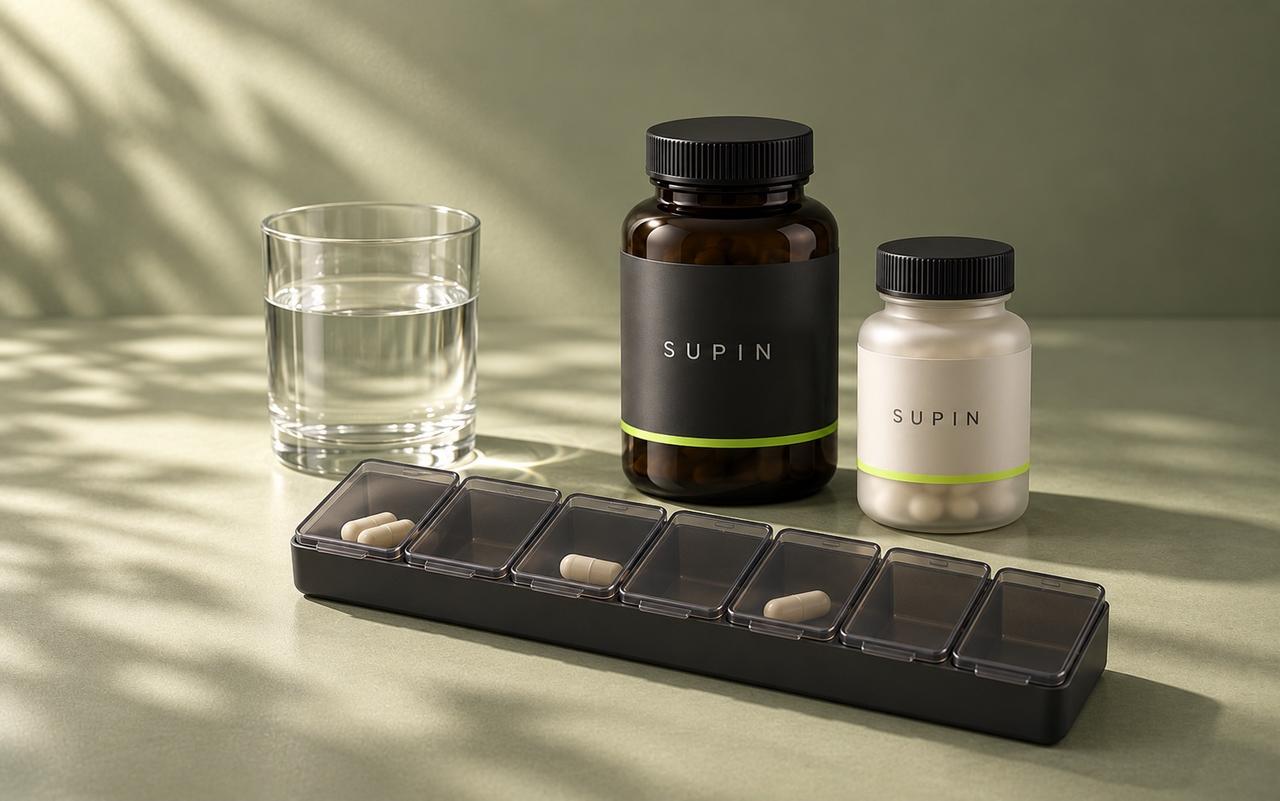
Yes, until the habit carries itself. Set one reminder for each slot, not one per bottle. A weekly pillbox lets you see at a glance whether you've taken today's slot.
Fill the pillbox on the same day each week, for example on Sunday evening. Powders and liquids can't go in a pillbox, so keep a note to take them at the time.
Step 6: How do I keep track of supply and refills?
Running out is one of the easiest ways for a routine to stop. Note how many capsules each bottle holds and how many you take a day, and you'll know roughly how many days it lasts. Reorder a few days before it runs out, not on the day.
Step 7: When should I review my supplement routine?
Keep a complete record of every supplement and medicine you take, with the name, amount, how often and why, and share it with your health care providers[1]. Review your routine with them:
- when you start or stop a prescription medicine;
- if you are pregnant, breastfeeding or trying to conceive;
- before any surgery[1];
- when new lab results come back;
- if you notice a bad reaction. Tell your doctor; you can also report it to the FDA[1].
How Supin helps
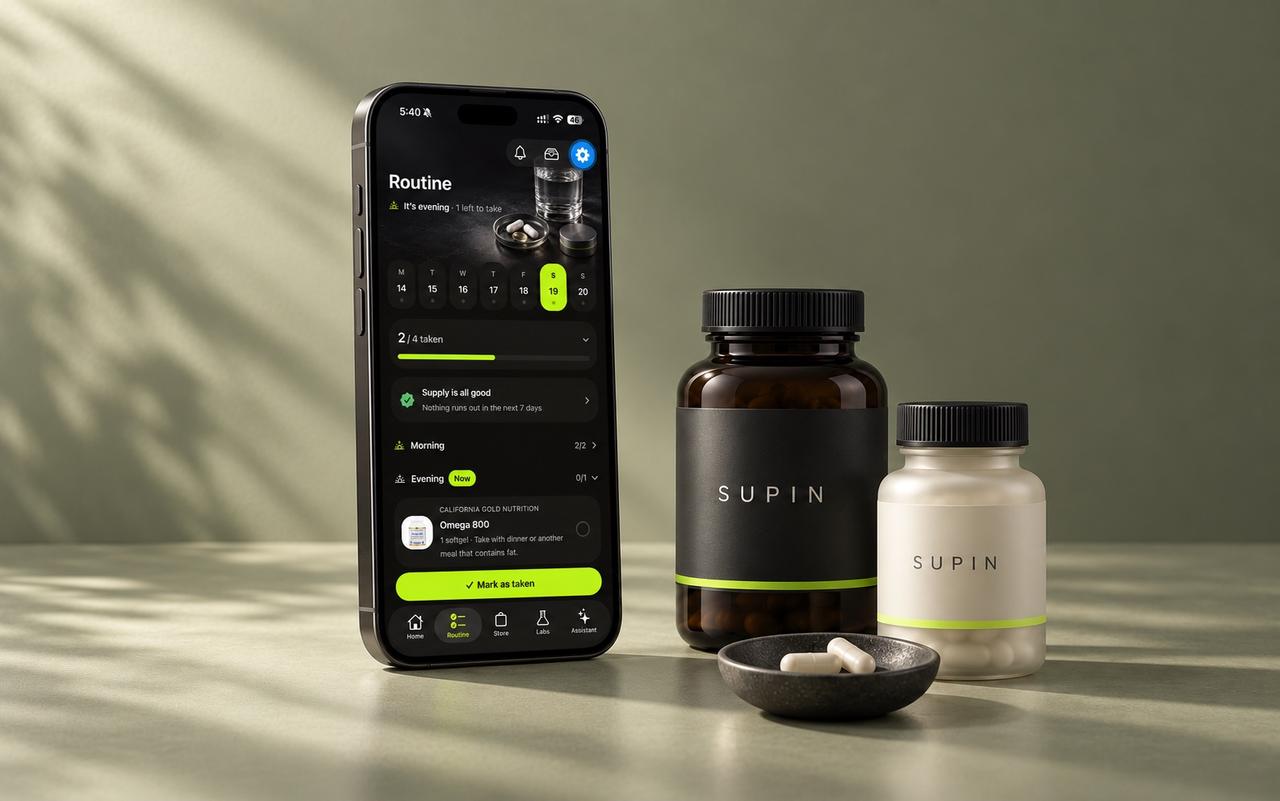
- Builds your routine from your goals, diet, health flags and the bottles you already own, and shows why each product is there.
- Daily nutrient totals add up every label in your routine, so overlaps are easy to spot.
- Reminders for morning, noon, evening and bedtime, with optional "Keep reminding me" repeats.
- Pills-left counts, a running-low heads-up about five days ahead, and a guided pillbox for the next seven days.
- A week view and a weekly card with doses taken and perfect-day streaks.
Start your routine with Supin, free on the App Store. New to the app? Read what Supin is or how it compares with other supplement trackers.
FAQ
Tie them to a fixed daily cue, such as breakfast. Repeating an action in the same context helps it become automatic[6]. Add a reminder for each part of the day until it does.
There's no set number, but taking many different supplements raises your chance of side effects[1]. Review your list with your doctor or pharmacist.
Not always. Some need a meal and some are best kept apart, such as calcium and iron[3]. Grouping into two or three slots usually covers both.
In habit research, a single missed day didn't seriously disrupt habit formation[6]. Pick up at your next slot, and follow the label or your pharmacist's advice instead of doubling up.
The NIH advises talking to your health care provider before using supplements to treat a condition, or together with prescribed medicines[1].
Sources
- NIH Office of Dietary Supplements — Dietary Supplements: What You Need to Know
- MedlinePlus — Vitamins
- NIH Office of Dietary Supplements — Iron fact sheet
- NIH Office of Dietary Supplements — Calcium fact sheet
- MedlinePlus — Levothyroxine
- Gardner B, Lally P, Wardle J. Making health habitual: the psychology of 'habit-formation' and general practice. Br J Gen Pract, 2012
Educational information, not medical advice. Check with your doctor or pharmacist before starting or changing supplements, especially if you take medication, are pregnant or have a health condition.