
Nutrients and stack score
See what your stack adds up to,and what to improve.
Suppin adds up the nutrients in everything you take from the labels, shows them against daily values and upper limits, and scores your stack out of 100.
Educational guidance, not medical advice.

How it works
- 1
Add what you take
Scan it, find it in the catalog, or let the routine add it.
- 2
Open Nutrients
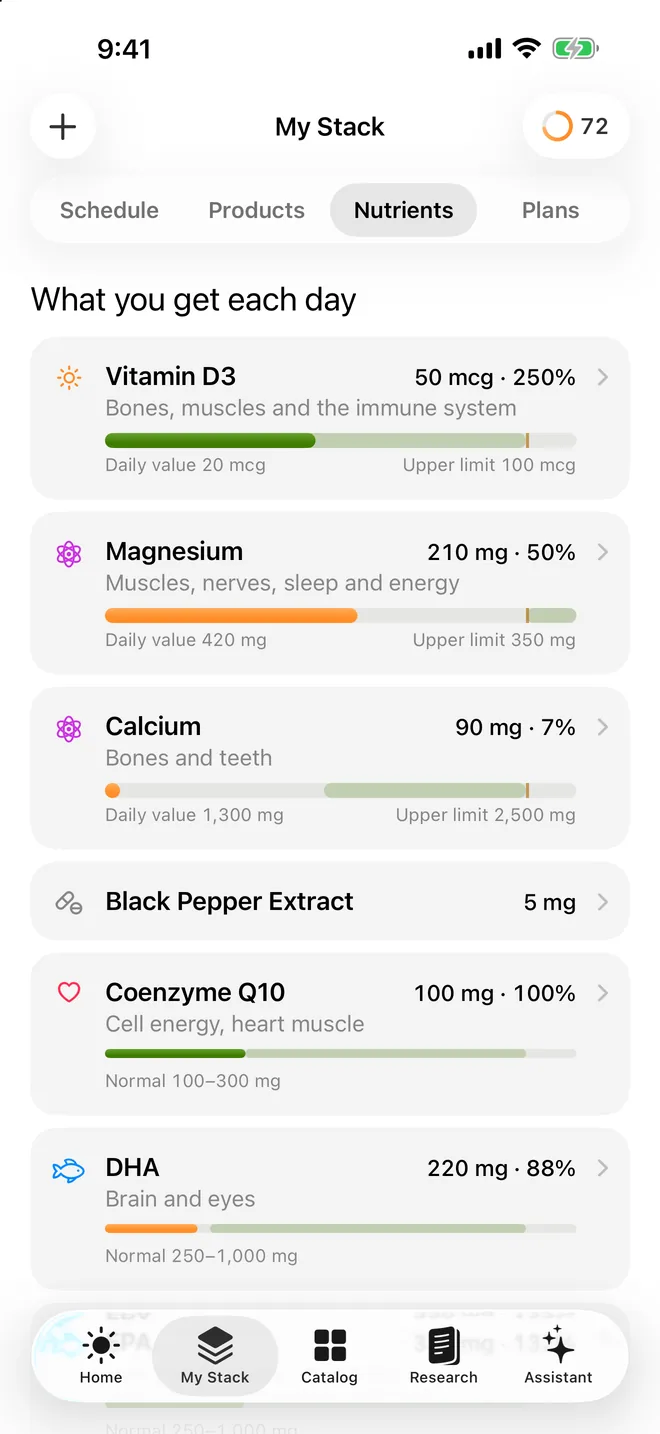
Each nutrient's daily total from the labels, against the daily value and the upper limit.
- 3
Check your stack score
Out of 100, from four parts: Goals, Dosage, Quality and Value.
- 4
Fix the top gaps
Follow “Top things to improve” and find a product that closes a gap.
Daily nutrient totals from your labels
When you take several products, the same nutrient often turns up in more than one. The Nutrients section in My Stack adds up what your stack gives you each day, taken from the labels, and shows each total as a share of the adult daily value, or of the typical adult amount when a label gives none. It shows which products each nutrient comes from. Food isn't counted. Going over 100% of the daily value is common and not a problem by itself; what matters is the upper limit.
Upper limits and doubling up
For nutrients that have a safe upper limit, such as vitamin D or zinc, the app shows when supplements alone take you above it and suggests checking with your doctor or pharmacist. Getting the same nutrient from three or more products is flagged too, so you can see where a multivitamin and a single-nutrient product overlap. The suggestion is to lower an amount or switch one product for one with less.
How the stack score works
The stack score rates your whole stack out of 100 in four parts. Goals (35%) measures how well what you take covers the essentials for the goals you picked; foundational essentials count most, supportive ones a third. Dosage (25%) compares each daily total with the amounts studied and the upper limit, and going over a limit counts double. Quality (25%) uses the products' quality scores, and Value (15%) their value per serving. A part without enough data is left out rather than guessed.
Built around your goals and your safety answers
The score follows the goals you chose, which you can change from My Stack. Nutrients that your health answers rule out, for example because of an allergy or a medicine you take, are left out of the score, so it never pushes you toward something that doesn't suit you. Iron isn't counted unless a doctor has advised it. The score is a way to see your stack at a glance, not a measure of your health.
Top things to improve
Below the score, the app lists the few changes that would raise it most: a goal essential missing from your stack, a nutrient below the studied amount, or one above its upper limit. Each comes with a way forward, such as finding a product in the catalog that contains that nutrient, or adding it to your routine. Before changing what you take, especially with a health condition or medication, check with a professional.
Questions about nutrients and stack score
In Suppin, it's a score out of 100 for everything you take together. It has four parts: Goals (35%), how well your stack covers the essentials for your goals; Dosage (25%), daily totals against studied amounts and upper limits; Quality (25%); and Value (15%). Parts without enough data are left out.
No. Daily totals come only from the supplement labels in your stack. The share of the daily value shows how much your supplements contribute; your diet adds to that, which is one reason going over 100% of the daily value isn't a problem by itself.
It flags any nutrient where your supplements together go above the safe daily upper limit, and nutrients you get from three or more products, and suggests checking with your doctor or pharmacist. It reads the amounts from the labels, so check that your products and how you take them are up to date.
No. The score describes your supplements: whether they cover the essentials for the goals you picked, in studied amounts, from good-quality products at fair value. It says nothing about your health, how you feel or whether a supplement works for you, and it isn't medical advice.
More answers on the FAQ page.