Omega-3 Supplements: How to Compare EPA and DHA on the Label
Why "fish oil 1,000 mg" tells you little: how to add up EPA and DHA, check serving size, form and source, and compare omega-3 products fairly.
7 min read
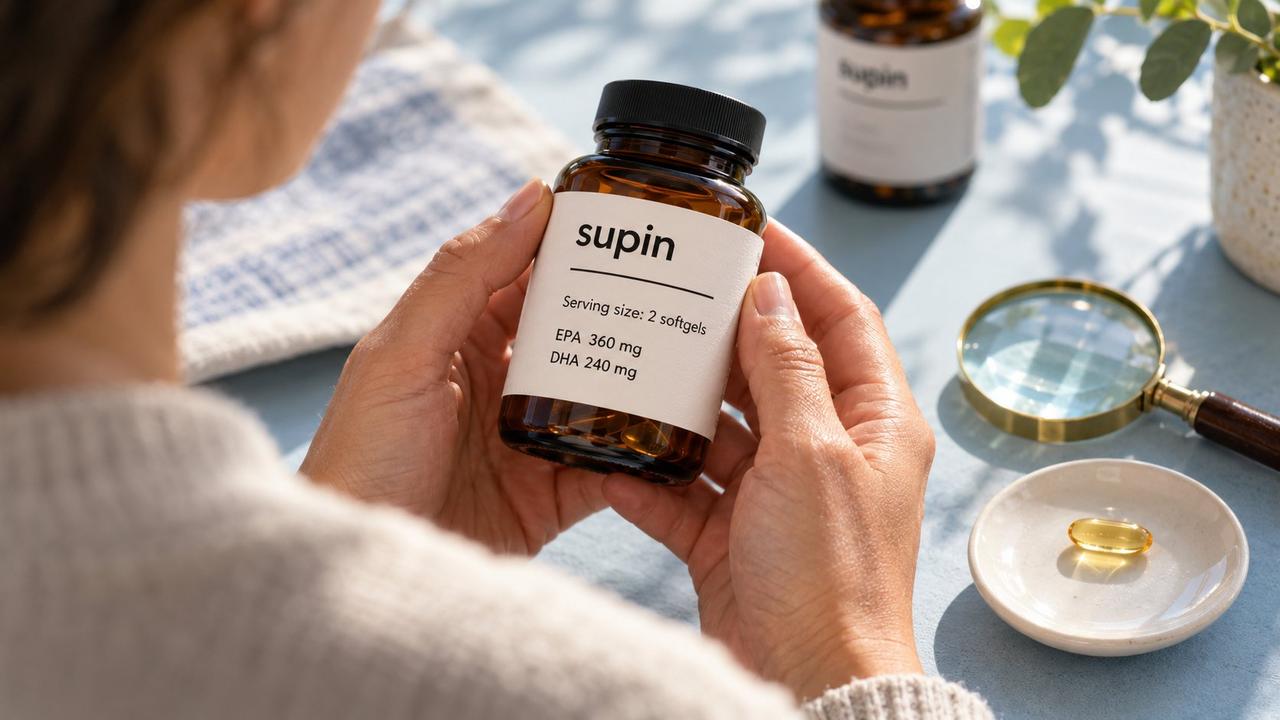
To compare omega-3 supplements, ignore the big "fish oil 1,000 mg" number and add up the EPA and DHA per serving instead. A typical 1,000 mg fish oil capsule contains about 180 mg EPA and 120 mg DHA, or 300 mg in total. Then check the serving size, the form and the source, and compare the price per gram of EPA plus DHA, not per capsule.
Two bottles can both say "1,000 mg" and deliver very different amounts of the omega-3s that matter. Here is how to read the label, what the official intake figures are and who should talk to a doctor first.
What do EPA and DHA mean on an omega-3 label?
EPA (eicosapentaenoic acid) and DHA (docosahexaenoic acid) are the long-chain omega-3s found in fish and algae, and they are the part of the product you are paying for. A third omega-3, ALA, comes from plant oils such as flaxseed, soybean and canola, and from chia seeds and walnuts. Your body can convert ALA into EPA and DHA, but only in small amounts, with reported conversion rates under 15%[1]. That's why the NIH says getting EPA and DHA directly from food or supplements is the only practical way to raise their levels[1].
On a Supplement Facts panel you'll usually see the total oil, then EPA and DHA on separate lines. Some labels also show a "total omega-3" figure, which can include omega-3s besides EPA and DHA, so add the two lines yourself. If a product lists only "fish oil" with no EPA or DHA amounts, you can't compare it properly. Our general guide on how to read a supplement label covers serving sizes and % Daily Value.
How do you compare two omega-3 supplements?
Work out the EPA plus DHA per serving, then per day at the dose you'll actually take, then the cost per gram. Here is an illustrative example of two labels:
| Label line | Product A | Product B |
|---|---|---|
| Front of bottle | Fish oil 1,000 mg | Fish oil 1,000 mg |
| Serving size | 1 softgel | 2 softgels |
| EPA per serving | 180 mg | 500 mg |
| DHA per serving | 120 mg | 250 mg |
| EPA + DHA per serving | 300 mg | 750 mg |
| EPA + DHA per softgel | 300 mg | 375 mg |
Product A matches the typical capsule the NIH describes: about 1,000 mg fish oil containing 180 mg EPA and 120 mg DHA[1]. Product B is more concentrated per softgel but asks you to take two. Neither is "better" until you divide the price by the EPA plus DHA you get.
Three things to watch:
- Serving size. The amounts in the panel are per serving, which may be two or three capsules.
- Front-label numbers. "1,000 mg" or "1,200 mg" usually refers to the whole oil, not to omega-3s.
- EPA-to-DHA balance. Products differ a lot. The research behind some health findings used specific amounts, so if your doctor has suggested a product for a reason, ask which amounts they mean.
How much EPA and DHA should you take a day?
There's no US recommended amount for EPA and DHA; in Europe, EFSA considers 250 mg a day of EPA plus DHA an adequate intake for healthy adults. The US only set an Adequate Intake for ALA: 1.6 g a day for men and 1.1 g for women[1]. EFSA describes 250 mg a day of EPA plus DHA as an adequate intake for maintaining general cardiovascular health in healthy adults[2].
Food comes first. The NHS recommends at least two portions of fish a week, one of them oily, such as salmon, sardines or mackerel, with a portion being about 140 g[3]. A supplement is mainly for people who don't eat fish.
On the upper end, EFSA found that supplemental EPA and DHA combined at up to 5 g a day raise no safety concerns for adults, but it did not set an upper limit[2]. The FDA has said supplements providing no more than 5 g a day of EPA and DHA are safe when used as recommended, and that supplement labels shouldn't recommend more than 2 g a day[1]. These are ceilings, not targets: follow the label.
Does the form of omega-3 matter (triglyceride vs ethyl ester)?
A little, but less than the amount of EPA and DHA. Omega-3s in supplements come as natural triglycerides, re-esterified triglycerides, ethyl esters, free fatty acids or phospholipids. The NIH says re-esterified triglycerides, natural triglycerides and free fatty acids have somewhat higher bioavailability than ethyl esters, but all forms significantly raise EPA and DHA levels in the blood[1].
Many labels don't state the form. If yours says "ethyl ester" or "EE", it isn't a reason to throw it away; it's one more line to weigh against price and dose. Taking fish oil with a meal is a sensible habit; see the best time to take supplements.
Fish oil, krill oil, cod liver oil or algal oil: which source?
- Fish oil is the most common source. The NIH says omega-3 supplements haven't been found to contain mercury, because it is removed during processing[1].
- Krill oil provides EPA and DHA too[1]; compare it by the same EPA plus DHA numbers.
- Cod liver oil also contains vitamin A and vitamin D[1]. Count those towards your daily totals. The NHS advises avoiding fish liver oil supplements if you're pregnant or trying for a baby unless your GP says otherwise, because they're high in vitamin A[3].
- Algal oil is the vegetarian source. Algae are where EPA and DHA originally come from in the marine food chain[1].
Our omega-3 guide covers the evidence on heart health, eyes and pregnancy in more depth.
Who should check with a doctor before taking omega-3?
- People taking warfarin or other blood thinners. Fish oil can have antiplatelet effects at high doses and might lengthen clotting times with warfarin, though most research found 3 to 6 g a day didn't significantly change anticoagulant status[1]. Ask before you start.
- People with heart disease or high cardiovascular risk. Two large trials found that 4 g a day of omega-3s for several years slightly increased the risk of atrial fibrillation in these groups[1].
- Anyone pregnant or trying to conceive, especially before choosing a cod liver oil product[3].
Side effects are usually mild: an unpleasant taste, bad breath, heartburn, nausea, stomach discomfort, diarrhoea, headache and smelly sweat[1].
How Suppin helps
- Scan a barcode or photograph the label to add a product, so you can compare what each bottle really contains.
- Each of the 17,000+ products in the catalog has a quality score out of 10 covering label, formulation, testing and certifications, reviews and brand, and value, plus a verdict on whether it suits you.
- The Nutrients tab adds up what all your products contain, including vitamin A and D from cod liver oil, against daily values and upper limits.
- Tell Suppin you take a blood thinner and products that may interact aren't added automatically; they show "Review with a professional".
Get Suppin on the App Store and use the supplement scanner on the omega-3 bottles you're comparing.
FAQ
No. A typical 1,000 mg fish oil capsule contains about 180 mg EPA and 120 mg DHA, or about 300 mg of these omega-3s[1]. Check the EPA and DHA lines on the panel.
Both are long-chain omega-3s, and official intake figures such as EFSA's 250 mg a day count them together[2]. If your doctor recommends a specific product, ask which amounts of each they want you to take.
Triglyceride forms have somewhat higher bioavailability than ethyl esters, but all forms significantly raise EPA and DHA levels[1]. The total EPA plus DHA matters more.
Yes, from algal oil supplements[1]. Plant foods such as flaxseed and walnuts provide ALA, which the body converts to EPA and DHA only in small amounts[1].
EFSA and the FDA both consider supplemental EPA plus DHA up to 5 g a day safe for adults[1][2], but 4 g a day for several years slightly increased the risk of atrial fibrillation in people with heart disease or at high risk[1]. Stay with the label dose unless your doctor advises otherwise.
Sources
- NIH Office of Dietary Supplements — Omega-3 fatty acids fact sheet
- EFSA — EFSA assesses safety of long-chain omega-3 fatty acids (2012)
- NHS — Fish and shellfish
Educational information, not medical advice. Check with your doctor or pharmacist before starting or changing supplements, especially if you take medication, are pregnant or have a health condition.